
 Admin
Admin

 22 Sep 2026
How to Choose the Best SEO Expert in Delhi NCR: A...
22 Sep 2026
How to Choose the Best SEO Expert in Delhi NCR: A...

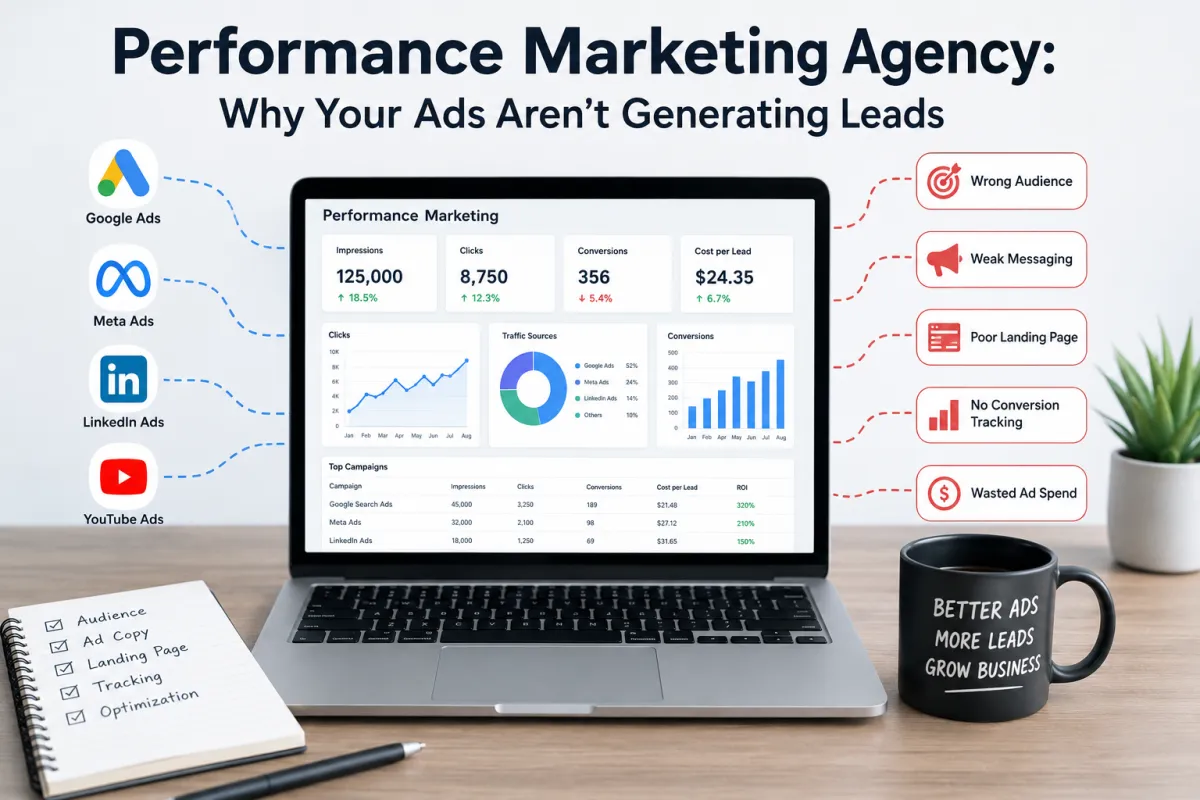
Businesses today spend thousands of dollars every month on digital advertising, expecting a steady flow of qualified leads and increased sales. Platforms like Google Ads, Facebook Ads, Instagram Ads, LinkedIn Ads, and YouTube Ads have made it easier than ever to reach potential customers. However, many businesses become frustrated when their advertising budget keeps increasing while inquiries remain low. They often believe that spending more money will automatically generate better results, but paid advertising doesn't work that way.
Successful advertising isn't about having the biggest budget. It's about understanding your audience, creating compelling campaigns, delivering the right message at the right time, and guiding visitors through a smooth conversion journey. Every click represents an opportunity, but without the right strategy, those opportunities quickly turn into wasted marketing spend.
If your campaigns are receiving impressions and clicks but very few enquiries, you're not alone. Many businesses face the same challenge because they focus only on launching ads instead of building a complete performance marketing strategy. Understanding why your ads aren't generating leads is the first step toward improving your return on investment and creating campaigns that consistently deliver measurable business growth.
One of the biggest misconceptions in digital advertising is that publishing an advertisement guarantees leads. While advertising platforms are incredibly powerful, they only help your business reach potential customers. Convincing those people to trust your brand and take action requires much more than simply appearing in front of them.
Many campaigns generate thousands of impressions and hundreds of clicks but fail to produce actual enquiries because the overall customer journey isn't optimized. Visitors may click an advertisement only to discover that the landing page doesn't answer their questions, loads slowly, or asks for too much information. Others may realize that the offer doesn't match what they expected after reading the advertisement.
Performance marketing is about optimizing every step of the customer's journey. From the first impression to the final enquiry form, every interaction influences whether someone becomes a lead or leaves your website. Businesses that focus only on ad creation often overlook these critical factors, resulting in disappointing campaign performance despite significant advertising investment.
Poor audience targeting remains one of the most common reasons advertising campaigns underperform. Showing your ads to people who have little interest in your products or services wastes valuable budget and reduces campaign efficiency. Even a perfectly designed advertisement cannot generate leads if it reaches the wrong audience.
Another major issue is weak messaging. Many advertisements talk only about the business rather than explaining how customers benefit. Modern consumers respond to clear solutions, measurable value, and genuine trust rather than generic promotional language. Your advertisement should immediately answer the visitor's biggest question: "Why should I choose this business?"
Landing page experience is another critical factor. A great advertisement can generate clicks, but if visitors arrive on a confusing or poorly designed page, they quickly leave without taking action. Slow loading speed, cluttered layouts, unclear calls-to-action, and lengthy enquiry forms significantly reduce conversion rates.
Businesses also frequently ignore conversion tracking. Without accurate tracking, it's impossible to identify which campaigns, keywords, audiences, or advertisements are producing real business results. Decisions become based on assumptions rather than data, making continuous improvement nearly impossible.
Poor keyword selection can also affect campaign performance. Choosing broad search terms often attracts visitors who are still researching rather than ready to buy. On the other hand, highly relevant commercial keywords usually generate better-quality traffic because users already have purchase intent.
Another overlooked factor is mobile optimization. Today, most users browse websites from smartphones. If your landing page isn't mobile-friendly, visitors may experience slow loading times, broken layouts, or difficult navigation. Even minor usability issues can dramatically reduce conversions.
Trust also plays a significant role in lead generation. Visitors are more likely to contact businesses that display customer reviews, testimonials, certifications, case studies, and clear contact information. Without these trust signals, many users hesitate to submit their details, regardless of how attractive the advertisement appears.
Many advertisers spend weeks perfecting their advertisements while giving very little attention to the landing page where visitors actually make their decision. In reality, the landing page often determines whether an advertising campaign succeeds or fails.
An effective landing page should continue the same message introduced in the advertisement. Visitors should immediately understand they're in the right place without searching for information. Clean layouts, persuasive headlines, relevant visuals, concise content, and prominent call-to-action buttons help maintain user attention.
Loading speed is equally important. Research consistently shows that users abandon websites that take more than a few seconds to load. Every additional second increases bounce rates and decreases conversions. Optimizing images, reducing unnecessary scripts, and improving website performance can significantly improve campaign results.
Simple enquiry forms also encourage more submissions. Asking only for essential information reduces friction and increases the likelihood that visitors will complete the process. Every unnecessary field creates another opportunity for potential customers to leave the page.
Launching advertisements is only the beginning of performance marketing. Successful campaigns require continuous monitoring, testing, and optimization. Businesses that leave campaigns unchanged for months often experience declining performance as competition, customer behaviour, and advertising algorithms evolve.
Poor optimization leads to higher costs, lower click-through rates, reduced Quality Scores, increasing cost-per-click, and fewer conversions. Instead of identifying these issues early, many businesses simply increase their advertising budget, believing additional spending will solve the problem. Unfortunately, higher spending usually magnifies existing inefficiencies.
Regular optimization allows marketers to pause underperforming advertisements, improve targeting, refine messaging, test different creatives, adjust bidding strategies, and improve landing page performance. Small improvements across multiple campaign elements often produce substantial gains in overall return on investment.
Many businesses eventually partner with a professional Lead Generation Company in Noida to identify hidden conversion barriers and improve campaign performance using detailed analytics, audience insights, and continuous optimization strategies.
Successful performance marketing campaigns usually share several important characteristics:
Clearly defined campaign objectives
Detailed audience research
Strong customer-focused messaging
Compelling ad creatives
High-quality landing pages
Fast website loading speed
Mobile-friendly user experience
Accurate conversion tracking
Continuous A/B testing
Smart budget allocation
Regular campaign optimization
Transparent performance reporting
These practices create a system where every part of the marketing funnel works together. Instead of relying on luck, successful businesses use data-driven decisions to improve campaign performance over time. This continuous improvement process helps reduce wasted advertising spend while increasing both lead quality and conversion rates.
Many advertisers celebrate high click-through rates without evaluating whether those clicks generate actual business value. While impressions and clicks provide useful information, they shouldn't be the primary indicators of success.
The most valuable performance metrics include Cost Per Lead (CPL), Conversion Rate, Customer Acquisition Cost (CAC), Return on Ad Spend (ROAS), lead quality, and revenue generated. These metrics provide a much clearer understanding of campaign effectiveness because they focus on business outcomes rather than platform activity.
Tracking customer behaviour after the initial click also reveals opportunities for improvement. Understanding where users leave the conversion process helps businesses optimize landing pages, simplify forms, improve messaging, and eliminate obstacles that prevent visitors from becoming customers.
Performance marketing should never be treated as a one-time campaign. Consumer preferences change, competitors launch new offers, advertising platforms update their algorithms, and market conditions continue evolving. Businesses that regularly test, measure, and improve their campaigns consistently outperform those relying on outdated strategies.
A sustainable marketing strategy combines audience research, compelling creative assets, optimized landing pages, continuous testing, detailed reporting, and ongoing campaign refinement. This approach not only generates more qualified leads but also improves customer experience and builds long-term brand credibility.
Businesses seeking consistent digital growth often work with a trusted Digital Marketing Company in Noida that focuses on measurable business outcomes instead of vanity metrics. The goal isn't simply attracting traffic but converting the right visitors into loyal customers through strategic optimization.
If your advertisements aren't generating leads, the problem usually isn't the advertising platform itself. More often, it's the overall marketing strategy behind the campaign. Weak audience targeting, ineffective messaging, poor landing pages, missing conversion tracking, and limited optimization can all prevent campaigns from delivering the results businesses expect.
Performance marketing succeeds when every stage of the customer journey is carefully planned and continuously improved. Instead of increasing your advertising budget without understanding the underlying issues, focus on creating better experiences for potential customers, measuring meaningful performance metrics, and making data-driven improvements over time.
Businesses that adopt this mindset don't just generate more leads—they generate better leads, improve return on investment, reduce wasted advertising spend, and build a scalable marketing system that supports long-term business growth.
Talk to our experts for a free strategy consultation tailored to your business goals.
Free Consultation WhatsApp Us

Effective SEO strategies not only elevate a website's visibility but also drive
targeted traffic, enhance user experience