
 Admin
Admin

 22 Sep 2026
How to Choose the Best SEO Expert in Delhi NCR: A...
22 Sep 2026
How to Choose the Best SEO Expert in Delhi NCR: A...

Building a professional website has become an important part of business growth. Whether you run a startup, IT company, real estate business, eCommerce store, local service company, or established enterprise, your website often becomes the first place where potential customers learn about your brand. However, when businesses begin planning a new website, one question often creates confusion: Do you need web design or web development?
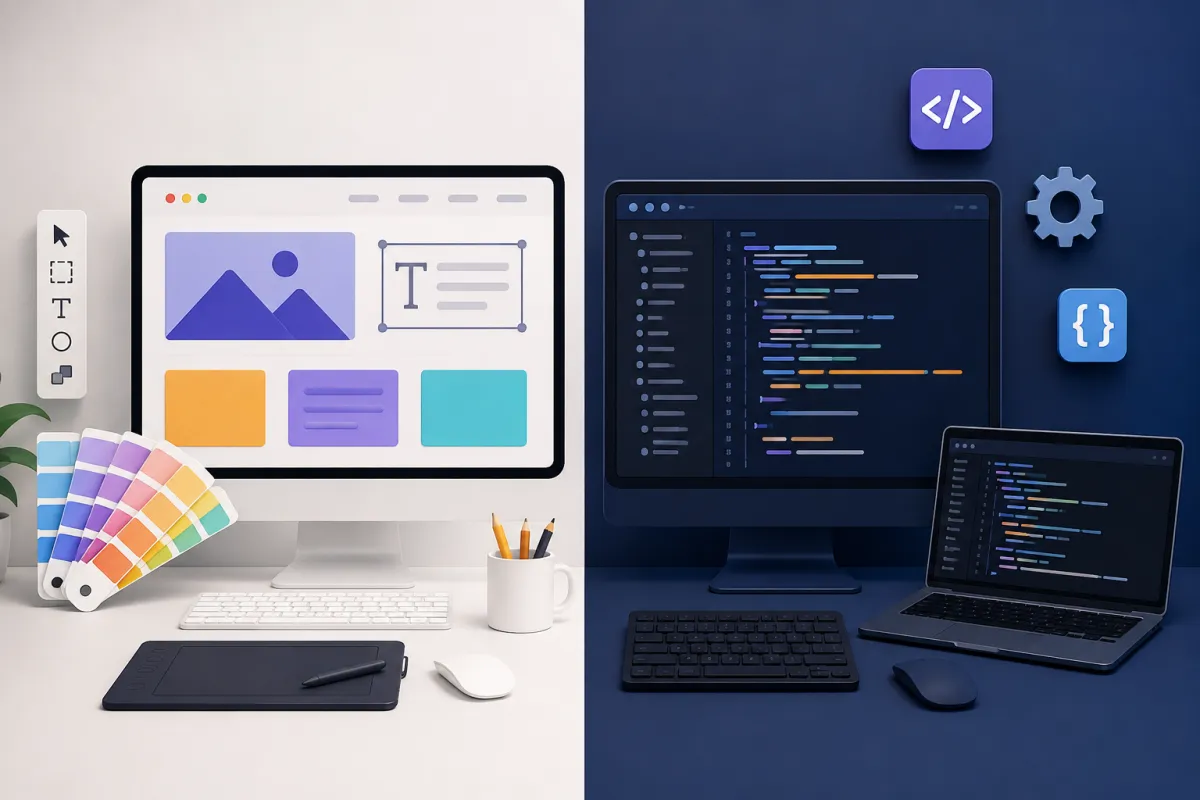
The terms are frequently used together, but they are not the same. Web design focuses mainly on the visual appearance and user experience of a website. Web development focuses on the technical structure, functionality, and systems that make the website work. Understanding this difference is important because choosing the wrong type of service can lead to unnecessary costs, missing features, or a website that does not properly support your business goals.
For businesses in Noida, the decision can be even more important because customers compare websites quickly. A modern website must look professional, load smoothly, work on different devices, and provide visitors with a clear path to take action. However, not every business requires a complex custom-built application, and not every business can succeed with only an attractive visual design. The right choice depends on what your website needs to do.
This guide explains the real difference between web design and web development, where the two services overlap, and how to identify what your business actually needs.
Web design is the process of planning how a website will look and how visitors will interact with it. It covers the visual structure of the website and helps create a clear, engaging experience for users. When someone opens a website, the layout, colors, fonts, images, menus, buttons, and overall presentation are all connected to web design.
Good design is not only about making a website attractive. It also helps visitors understand information quickly. A professional website should guide users naturally from one section to another without creating confusion. If a visitor cannot understand what a business offers within the first few seconds, the design and content structure may not be doing their job effectively.
Web designers generally focus on page layouts, branding consistency, visual hierarchy, navigation, typography, responsive layouts, and user interface elements. They consider where important information should appear and how users are likely to interact with the website.
For example, a visitor may land on the homepage of a service business looking for pricing or contact information. A well-designed website makes that information easy to find. The user should not have to open several pages or search through large blocks of text. Good web design creates a smoother journey and reduces unnecessary friction.
Web design is therefore closely connected to user experience. A website can contain excellent information and useful services, but visitors may still leave if the design feels outdated, confusing, or difficult to use.
Web development is the technical process of building the website and making its features work. It transforms the planned website design into a functioning digital platform. Development can range from building simple business websites to creating complex applications with user accounts, databases, payment systems, dashboards, and automation.
A developer handles the technical logic behind the website. When a user submits a form, adds a product to a cart, creates an account, books an appointment, or makes an online payment, development is responsible for processing those actions correctly.
Web development may involve front-end technologies, back-end systems, databases, server infrastructure, content management systems, APIs, security, and custom functionality. The exact technologies depend on the requirements of the project.
For a basic informational website, development requirements may be relatively simple. A service business may only need a few pages, enquiry forms, content management, and responsive functionality. In contrast, an eCommerce platform may require product management, customer accounts, secure payment processing, order tracking, and inventory systems.
The main purpose of web development is to make sure the website performs the tasks required by the business and its users.
The easiest way to understand the difference is that web design focuses on how a website looks and feels, while web development focuses on how the website works.
A web designer may decide how a product page should look, where the product image should be placed, and how the call-to-action button should appear. A web developer makes sure the button actually adds the product to the cart and connects the order to the relevant system.
The two services work together. Design creates the visual experience, while development creates the technical functionality behind that experience.
Neither one should be considered automatically more important than the other. Their importance depends on the type of project. A simple business website may require greater attention to design and content presentation, while a complex online platform may require more development work.
Front-end development sits between design and development because it focuses on the visible part of the website that users interact with. A front-end developer takes the visual design and turns it into responsive, interactive web pages.
This includes the visible layout, menus, buttons, forms, animations, and other interactive elements. Front-end development helps ensure that the website works properly across desktops, laptops, tablets, and mobile devices.
A design may look perfect as a static visual concept, but it must still be translated into a functioning website. This requires attention to responsiveness, browser compatibility, performance, and usability.
For this reason, web design and front-end development are closely connected but remain different skills. Design determines the intended experience, while front-end development implements that experience in the browser.
Back-end development focuses on the parts of a website that users usually do not see. It handles the business logic, database operations, authentication, server-side processing, and system integrations.
For example, a customer may log into an account and view previous orders. The visual account page is visible to the user, but the data that identifies the user and retrieves the order history is managed through back-end functionality.
Back-end development becomes especially important for websites and applications that require dynamic content, user accounts, custom workflows, advanced search, online transactions, or integration with other software.
A website with a large amount of custom functionality needs a strong technical foundation. Poor development can lead to slow performance, security issues, broken features, and difficulty maintaining the website as the business grows.
You may primarily need web design when the main problem is related to appearance, usability, branding, or how visitors interact with the website. This is often the case when an existing website functions correctly but looks outdated or fails to provide a modern user experience.
A business may consider focusing on web design in situations such as:
A redesign can improve the first impression of a business and make the website easier to understand. However, the redesign should not only focus on colors or images. It should consider how real users navigate through the website and what information they need.
A company website, portfolio website, brochure website, or informational website often places significant importance on design because its main purpose is communication and lead generation.
You primarily need web development when your website requires advanced or custom functionality. If the website needs to perform specific tasks rather than simply display information, development becomes essential.
Common examples include websites that require customer accounts, appointment systems, online payments, subscription management, databases, dashboards, automated workflows, or third-party integrations.
An eCommerce website is a good example. It needs more than attractive product pages. Users must be able to search for products, add them to a cart, complete a secure checkout, receive confirmation, and track their orders. The business must also be able to manage products and orders.
Similarly, a custom business platform may need different users to access different information based on their role. This requires authentication, permissions, data processing, and database management.
These are primarily development challenges, although design still plays an important role in making the final system easy to use.
Most modern websites require a combination of web design and web development. The difference lies in how much emphasis each project places on design or development.
A website can have excellent functionality but still create a poor experience if users cannot understand how to use it. At the same time, a beautiful website cannot achieve its full purpose if important features do not work properly.
Consider an online appointment booking website. Good design helps visitors select a service, choose an available date, and understand the booking process. Development manages the appointment data, available time slots, confirmations, and any payment processing.
Both sides are necessary.
The best website projects usually begin with clear planning. Before deciding on design or development, a business should understand what the website needs to achieve and what actions users need to perform.
The first step is to identify the main purpose of your website. A local service provider, online store, startup, and technology company may all need very different solutions.
A simple informational website may only need pages that explain services, display business information, and allow visitors to make an enquiry. A content-focused design with standard website functionality may be sufficient.
An eCommerce business needs a more advanced platform because users must browse products and complete transactions. A custom software company may require a complete web application with advanced user management and data processing.
The most useful question is not simply, “Do I need web design or web development?” Instead, ask, “What does my website need to allow users to do?”
If users only need to read information and contact your business, the development requirements may be relatively simple. If they need to create accounts, manage information, make payments, or use custom features, more advanced development is likely required.
Responsive design is now a basic requirement for modern websites. Users access websites through smartphones, tablets, laptops, and desktop computers, and the experience should remain usable across different screen sizes.
Responsive design ensures that layouts, text, images, menus, and interactive elements adjust according to the device. A website that looks excellent on a large desktop screen but becomes difficult to use on a mobile phone can create a poor experience.
Mobile usability is particularly important because users often search for local services while using their phones. They may want to quickly understand the service, view business details, call the company, or submit an enquiry.
Responsive design is primarily connected with web design, but its implementation requires front-end development. This is another example of why the two disciplines must work together.
Search engine performance is another area where design and development both matter. Search engines evaluate websites using multiple signals, including mobile usability, page experience, content structure, technical accessibility, and performance.
Web design can influence how easily users understand and navigate a website. Clear navigation, readable content, logical page structures, and mobile-friendly layouts can improve the overall user experience.
Web development can influence page speed, technical accessibility, website security, structured data, crawlability, and other technical SEO factors. A poorly developed website may load slowly or create technical barriers that make it more difficult for search engines to process the site.
However, SEO should not be treated as something that is added only after a website is complete. Website structure, development decisions, content organization, and performance planning can all affect long-term search visibility.
A business looking for the Best Website Development Company Noida should therefore consider technical quality, performance, scalability, and the company's ability to understand website goals rather than choosing only based on visual examples or pricing.
A local service business usually needs a clear and trustworthy website that explains what it offers and makes it easy for customers to contact the company. Good design, mobile responsiveness, service pages, enquiry forms, and basic development may be sufficient.
An eCommerce business needs a more comprehensive combination of design and development. Product presentation is important, but so are the systems behind the website, including product management, payments, orders, and customer accounts.
A startup may need a custom solution depending on its business model. Some startups only need a professional marketing website, while others require a complete application. The difference should be understood before development begins.
A large organization may need custom integrations, employee portals, data dashboards, or systems connected to existing software. These projects require detailed technical planning and a stronger development focus.
For businesses planning a website redesign, the main question should be whether the current technical platform is still suitable. If the existing system works well but the website looks outdated, a redesign may be enough. If the current website has serious performance, security, or functionality limitations, redevelopment may be necessary.
Selecting the right company should begin with understanding your requirements. Businesses should avoid focusing only on the visual portfolio or the lowest project price. A website is a long-term digital asset, and the right solution should support future requirements.
Review the type of websites and platforms a company has previously worked on. A company that creates attractive informational websites may not necessarily have experience developing complex applications. Similarly, a company with strong technical skills should also understand how to create a usable customer experience.
Businesses should also ask about the process used to understand requirements, plan the website, test features, and provide support after launch. A good website project should include sufficient planning before the final development stage begins.
When comparing options for the Best Website Designing Company Noida, look for strong usability, responsive layouts, clear visual communication, and designs that support the actual goals of the business rather than simply focusing on decorative effects.
One common mistake is starting a website project without clearly defining the required functionality. Businesses may request a visually attractive website and later discover that they need custom features that were not included in the original plan.
Another mistake is copying the design of a competitor without considering the needs of the target audience. A website should reflect the business, its customers, and the actions visitors need to take.
Some businesses also focus too heavily on appearance while ignoring speed, scalability, and technical quality. Others do the opposite by creating complex systems that users find difficult to navigate.
A successful website should balance functionality and simplicity. Every feature should have a clear purpose.
The choice between web design and web development depends entirely on what you want your website to achieve.
Web design is essential when the focus is on appearance, branding, navigation, and user experience. Web development becomes essential when the website needs custom functionality, data processing, accounts, payments, integrations, or complex business systems.
For many businesses, the answer is not choosing one service over the other. Modern websites usually require both, with the balance depending on the project.
Before starting your website project, define the purpose of the website, the type of users you want to serve, and the actions those users need to perform. Consider not only what the website needs today but also how your requirements may change as the business grows.
A visually appealing website can help create trust and communicate your brand effectively. Strong development can provide the performance and functionality required to support real business operations. When these two elements are planned together, businesses can create websites that are easier to use, more reliable, and better prepared for long-term growth.
The most important decision is therefore not simply choosing web design or web development. It is understanding your actual business requirements first and then building the right combination of design, technology, performance, and functionality around those needs.
Talk to our experts for a free strategy consultation tailored to your business goals.
Free Consultation WhatsApp Us

Effective SEO strategies not only elevate a website's visibility but also drive
targeted traffic, enhance user experience