
 Admin

 22 Sep 2026
How to Choose the Best SEO Expert in Delhi NCR: A...

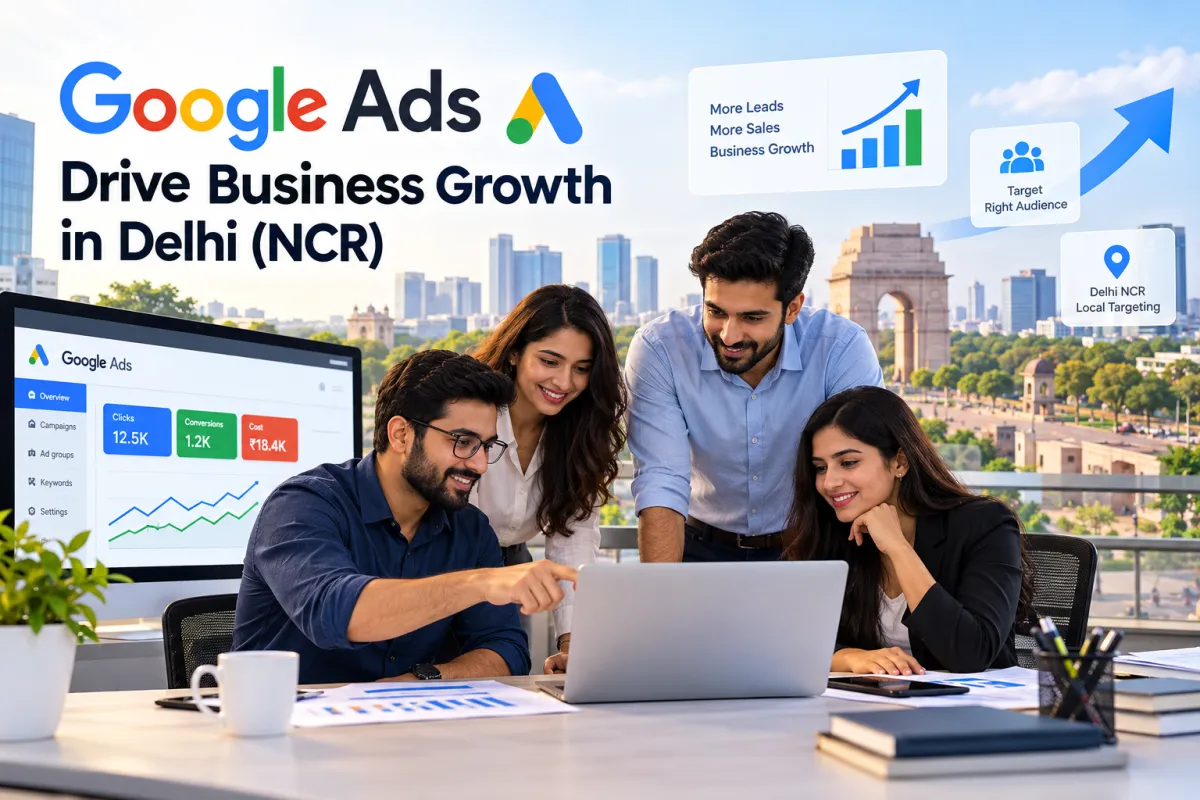
In 2026, online advertising has become one of the most important ways for businesses to reach potential customers, generate leads, increase sales, and build a strong digital presence. With more businesses competing for attention across search engines, social platforms, and online marketplaces, simply having a website is no longer enough. Companies need a well-planned paid advertising strategy that reaches the right audience at the right time while keeping advertising costs under control. Google Ads remains one of the most powerful platforms for businesses that want measurable and targeted results from digital advertising.
Delhi NCR is one of India's largest business markets, with startups, local businesses, service providers, e-commerce companies, educational institutions, healthcare providers, real estate companies, technology firms, and professional service businesses competing for customers every day. Because competition is high, businesses need more than generic advertising campaigns. They need carefully researched keywords, attractive advertisements, optimized landing pages, accurate audience targeting, continuous campaign monitoring, and data-driven decision-making.
Consumer behavior has changed significantly over the last few years. People increasingly use Google to research products, compare services, find nearby businesses, check prices, read reviews, and make purchasing decisions. This creates a valuable opportunity for businesses to appear in front of customers when they are already searching for a solution.
Unlike many traditional forms of advertising, Google Ads can provide businesses with greater control over where and when their advertisements appear. A company can target specific locations, devices, audiences, search terms, and customer interests. This makes paid search particularly useful for businesses that want to generate qualified traffic rather than simply increase website visits.
For example, a local service provider in Delhi can target customers searching within selected areas of Delhi NCR. An e-commerce company can promote specific products to users who are actively searching for them. A B2B company can focus its campaigns on commercial keywords and specific audience segments. With proper planning, businesses can create campaigns that are closely aligned with their marketing objectives.
Successful paid advertising is not simply about creating an advertisement and setting a daily budget. A strong campaign requires research, planning, implementation, testing, and continuous optimization. Professional campaign management begins by understanding the business, its customers, competitors, products, services, margins, and goals.
Keyword research is one of the most important parts of the process. The objective is to identify search terms that have commercial value and are relevant to the products or services being promoted. At the same time, irrelevant searches need to be filtered out so that advertising budgets are not wasted on users who are unlikely to convert.
Ad copy also plays a major role. A good advertisement should immediately communicate what the business offers and why a potential customer should consider it. Clear messaging, strong calls to action, relevant offers, and accurate information can improve the quality of traffic generated through advertising.
Landing pages are equally important. Sending every visitor to a generic homepage may not always provide the best experience. A dedicated landing page can focus on one product, service, offer, or customer requirement. When the advertisement and landing page provide a consistent experience, visitors are more likely to take the desired action.
Managing paid advertising campaigns requires regular attention. Search trends change, competitors adjust their strategies, advertising costs fluctuate, and customer behavior evolves. A campaign that performs well today may require adjustments tomorrow.
Professional PPC management involves reviewing campaign performance and identifying areas that need improvement. This may include adjusting bids, changing keyword targeting, testing new advertisements, improving landing pages, refining audience targeting, and controlling unnecessary spending.
A professional approach also focuses on conversion quality instead of relying only on clicks. Getting a large number of website visitors does not necessarily mean a campaign is successful. The real objective is to generate meaningful actions such as phone calls, enquiries, form submissions, bookings, purchases, or qualified leads.
For businesses operating in a competitive market, choosing the Best Google Ads Agency in Delhi (NCR) can provide access to experienced campaign planning, performance analysis, conversion tracking, and ongoing optimization. The right agency should understand that every business has different goals and should create campaigns according to the company's specific market, audience, budget, and growth objectives.
A complete paid advertising strategy can involve several different campaign types depending on the business model. Search campaigns are commonly used to reach people actively searching for specific products or services. Display campaigns can help businesses build awareness across websites and digital properties. Shopping campaigns can be valuable for online stores that want to promote products directly in search results.
Video advertising can help businesses communicate their value through visual storytelling, while remarketing campaigns can reconnect with people who have previously visited a website or interacted with a business online. Performance-focused campaign formats can also help businesses reach potential customers across multiple Google properties.
The most suitable combination depends on the company's objectives. A local service company may focus heavily on search and call-driven campaigns, while an online retailer may benefit from product-focused advertising. A company launching a new brand may require a broader combination of awareness and conversion campaigns.
Successful campaigns usually share several important characteristics. First, they have clearly defined objectives. A business should know whether it wants leads, sales, phone calls, website enquiries, app installations, bookings, or another measurable outcome.
Second, successful campaigns use accurate conversion tracking. Without reliable tracking, it becomes difficult to understand which campaigns, keywords, advertisements, or landing pages are actually producing results.
Third, successful campaigns are continuously optimized. Advertising should not be treated as a one-time activity. Performance data should be reviewed regularly to identify opportunities and problems.
Fourth, successful campaigns focus on relevance. Keywords, advertisements, landing pages, and offers should work together. When users find exactly what they were looking for, the overall customer experience becomes stronger.
Finally, successful campaigns use budgets strategically. Increasing the budget does not automatically guarantee better results. Budget allocation should be based on performance, business priorities, conversion quality, and available market opportunities.
Working with an experienced advertising agency can save businesses considerable time and provide access to specialized knowledge. Instead of spending hours researching keywords, creating advertisements, analyzing reports, and monitoring campaigns, business owners can focus on their core operations.
An experienced team can also identify opportunities that may not be obvious to someone managing campaigns occasionally. For example, an agency may identify expensive keywords that are producing poor-quality leads or discover search terms that generate strong conversion rates.
Another advantage is ongoing testing. Different headlines, descriptions, landing pages, audiences, offers, and bidding approaches can be tested to determine which combinations perform better. Over time, these improvements can contribute to stronger campaign efficiency.
Agencies can also provide regular performance reports that help businesses understand where their advertising budget is being spent and what results are being generated.
Choosing an advertising partner requires more than searching for an agency and selecting the first result. Businesses should evaluate an agency's experience, approach, communication process, reporting system, understanding of the target industry, and ability to measure results.
It is useful to ask how the agency handles keyword research, negative keywords, conversion tracking, landing-page recommendations, campaign optimization, budget management, and reporting. Businesses should also understand what metrics the agency considers important.
Transparency is particularly important. A reliable agency should clearly explain campaign performance and avoid making unrealistic promises. No legitimate advertising professional can guarantee a specific number of leads or sales because performance depends on competition, market demand, pricing, website quality, customer behavior, and many other factors.
Businesses should also consider whether the agency provides customized strategies rather than using exactly the same campaign structure for every client.
For businesses serving customers in Delhi NCR, location targeting can be particularly valuable. Instead of showing advertisements across an entire country, businesses can focus their budget on areas where their services are actually available.
Local campaigns can help businesses reach potential customers searching for services in specific locations. This is particularly useful for home services, healthcare providers, educational institutes, real estate companies, restaurants, repair services, professional services, and local retailers.
Location-based advertising can also be combined with appropriate landing pages and strong calls to action. When customers can quickly understand the service area, contact information, pricing information, and benefits, they can make decisions more easily.
Even an excellent advertising campaign can struggle if the landing page provides a poor user experience. Visitors expect the page to load quickly, work properly on mobile devices, provide relevant information, and make the next step clear.
A good landing page should match the message used in the advertisement. If an advertisement promotes a particular service or offer, visitors should immediately find information about that same service or offer after clicking.
The page should also provide clear contact options and eliminate unnecessary distractions. Depending on the business, this may include a contact form, phone number, booking option, product information, pricing details, customer reviews, or frequently asked questions.
One of the biggest advantages of digital advertising is the ability to measure performance. Businesses can monitor metrics such as impressions, clicks, click-through rate, cost per click, conversions, conversion rate, cost per conversion, and return on advertising investment.
However, individual metrics should not be analyzed in isolation. A campaign with a low cost per click may still be ineffective if the traffic does not generate customers. Similarly, a campaign with a higher cost per click may be profitable if it produces valuable leads or sales.
The most important metrics should therefore be connected to the actual business objective. For a lead-generation business, qualified leads and cost per qualified lead may be more important than total clicks. For e-commerce, revenue and return on advertising spend may be more meaningful.
The digital advertising environment will continue to become more competitive in 2026. Businesses should therefore focus on building campaigns that are flexible and data-driven rather than relying on outdated advertising methods.
Automation and machine learning are becoming increasingly important within digital advertising platforms, but human strategy remains valuable. Businesses still need to provide accurate information, define meaningful conversion goals, understand their customers, develop compelling offers, and evaluate campaign performance.
The strongest approach combines technology with strategic thinking. Automation can help with optimization and audience discovery, while experienced marketers can interpret business goals, customer intent, competitive conditions, and campaign data.
Companies should also consider how paid advertising works alongside SEO, content marketing, social media, email marketing, and other digital channels. Google Ads can generate immediate visibility, while organic marketing can help build long-term online authority. Combining these approaches can create a more balanced digital marketing strategy.
Google Ads can be a powerful growth channel for businesses that want to reach customers actively searching for products and services. However, successful advertising requires much more than putting money into a campaign. Businesses need accurate targeting, relevant keywords, persuasive advertisements, optimized landing pages, reliable conversion tracking, continuous testing, and careful budget management.
For companies in Delhi NCR, competition can be intense across almost every major industry. A professionally planned advertising strategy can help businesses reach relevant audiences, generate better-quality enquiries, improve online visibility, and make more informed marketing decisions.
The most effective approach is to treat Google Ads as an ongoing growth process rather than a short-term promotional activity. By consistently analyzing performance, improving campaigns, understanding customer behavior, and adapting to changes in the advertising landscape, businesses can create a stronger foundation for sustainable digital growth throughout 2026 and beyond.
Talk to our experts for a free strategy consultation tailored to your business goals.
Free Consultation WhatsApp Us

Effective SEO strategies not only elevate a website's visibility but also drive
targeted traffic, enhance user experience